project contracting
High-efficiency sedimentation technology

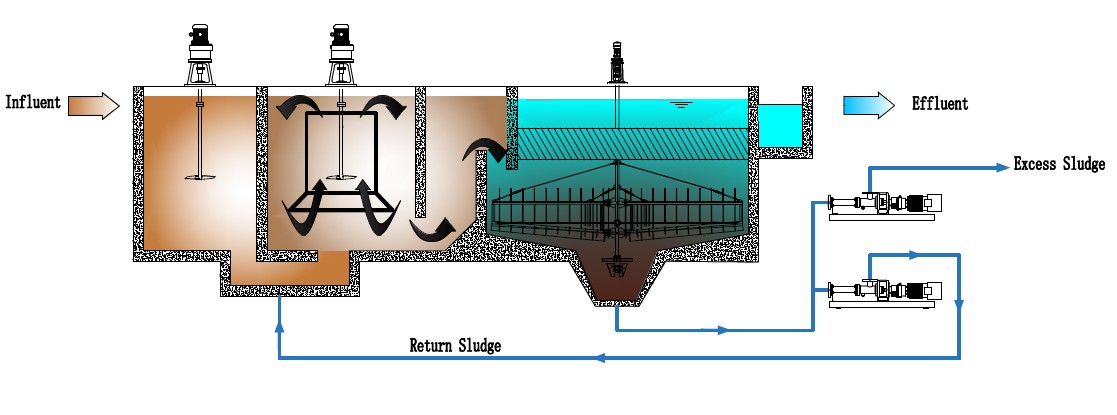
High-efficiency sedimentation technology
High-efficiency sedimentation technology is a technical combination that significantly improves sedimentation efficiency by optimizing hydraulic conditions, adding sludge reflux, and improving flocculant dosing based on traditional sedimentation technology.

Core principle
Its core technical principles include:
Contact Flocculation Mechanism:
A high-concentration suspended floc layer is maintained in the reaction zone through a sludge recirculation system. Fine particles in the raw water collide with and adsorb onto the recirculated flocs, forming larger and denser floc particles.
Inclined Tube/Plate Separation Technology:
Inclined tubes or plates are installed in the sedimentation zone to increase the sedimentation area and shorten the particle settling distance, significantly improving separation efficiency.
Chemically Enhanced Phosphorus Removal:
By adding coagulants (such as PAC, PFS, etc.) and flocculants (such as PAM), phosphates in the water form insoluble precipitates, which are then removed through co-precipitation by flocculation5.
Efficient sedimentation technology usually integrates "rapid mixing-flocculation reaction-sedimentation separation" three units. Through precise control of hydraulic retention time, stirring intensity, and sludge recirculation flow, optimal treatment effects are achieved. Among them, the retention time in the rapid mixing zone is about 1-2 minutes, the flocculation reaction zone is 15-20 minutes, and the surface load of the sedimentation zone can reach 15-30m³/(m²·h), which is much higher than traditional sedimentation tanks.
Applicable scenarios
High-efficiency sedimentation technology is widely used in scenarios requiring enhanced solid-liquid separation:
Upgrading and renovation of wastewater treatment plants:
Especially suitable for renovation projects requiring upgrading from Class 1B to Class 1A standards, or from Class 1A to surface water Class IV/V standards. It can efficiently remove SS, TP, and some COD.
Industrial wastewater treatment:
Suitable for removing heavy metals and refractory substances from wastewater in industries such as chemicals, electroplating, and metallurgy, with strong impact load resistance.
Stormwater treatment:
Used for treating initial rainwater and combined sewer overflow pollution, rapidly reducing pollutant loads and preventing water from becoming black and odorous.
Water supply treatment:
Used for the pretreatment of high-turbidity raw water, it can quickly reduce turbidity and alleviate the subsequent treatment load.
Pre-treatment before advanced treatment:
As a pre-treatment unit for advanced treatment processes such as denitrification deep-bed filters and ozone oxidation, it ensures stable influent water quality.
Performance statement
No. | Project Name | Specification | Project Location | Remarks |
1 | Fujian Diqiao - Procurement Contract for parts of high-efficiency sedimentation tank equipment | Quanzhou, Fujian | ||
2 | Tai'an High-tech Zone New Material Industrial Park Sewage Treatment Center EPC Project Equipment Procurement and Installation Subcontract | 8000m3/d | Tai'an, Shandong | |
3 | Lianshui County New Material Industrial Park Sewage Treatment Plant | Huai'an, Jiangsu | ||
4 | Shanghai Water Industry - Fuyang Sewage Treatment Phase V Project EPC high-efficiency sedimentation tank equipment | Hangzhou, Zhejiang |