project contracting
Sludge deep dewatering and drying technology

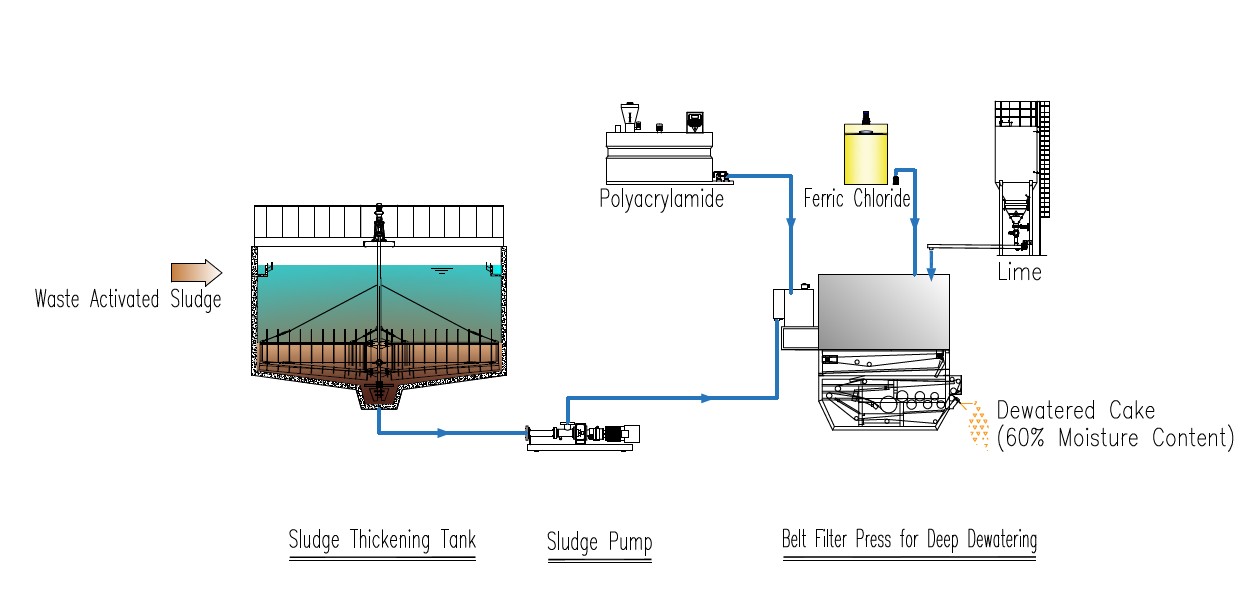
Deep sludge dewatering and drying technology
This technology is a combined process for sludge reduction, stabilization, and resource recovery that integrates "deep dewatering" pretreatment with "heat pump low-temperature drying" core treatment. The goal is to gradually process raw sludge with a moisture content as high as 97%-99% to below 40%, significantly reducing sludge volume and creating conditions for subsequent disposal or resource utilization.

Core principle
(1) Technical Principle of Deep Dewatering
Deep dewatering is a pre-treatment stage for sludge drying, aiming to further reduce the water content of the sludge from approximately 80% after conventional mechanical dewatering (such as belt filter pressing and centrifugal dewatering) to below 60%.
· Chemical Conditioning: Adding specialized chemical conditioning agents (such as iron salts, aluminum salts, lime, and organic polymer flocculant PAM, etc.) to sludge with a water content of about 80%. These agents, through mechanisms like charge neutralization and adsorption bridging, destroy the combined structure of water and colloidal particles in the sludge, converting a large amount of internal combined water (such as capillary combined water and adsorbed water) into free water that is easy to remove.
· Physical Pressing: Chemically conditioned sludge is sent to high-pressure filter press equipment (such as diaphragm filter presses or plate and frame filter presses). The equipment first performs filling filtration under lower pressure, and then applies extremely high pressure (usually 1.6-3.0 MPa) to the diaphragm or plate frame for secondary pressing of the sludge, forcefully squeezing out the water released after chemical conditioning.
Through deep dewatering, the sludge water content is significantly reduced and the volume is greatly decreased, reducing energy consumption and processing load for the subsequent low-temperature drying process.
(2) Technical Principle of Heat Pump Low-temperature Drying
Heat pump low-temperature drying is the core of this technology, utilizing a heat pump system to dry deep-dewatered sludge in a closed low-temperature environment.
· Heat pump system (refrigeration cycle): The core working principle of the heat pump system is similar to that of air conditioners or refrigerators, achieving heat transfer through the phase change cycle of the refrigerant (evaporation heat absorption - compression heating - condensation heat release - throttling expansion).
· Evaporator (heat absorption end): In the drying box, the low-temperature and low-pressure liquid refrigerant evaporates in the evaporator, absorbing heat from the humid hot air, reducing the air temperature below the dew point, and the water vapor therein is condensed into liquid water and discharged. This process achieves dehumidification of the drying exhaust gas.
· Compressor: Low-temperature and low-pressure gaseous refrigerant that has absorbed heat is compressed by the compressor, becoming a high-temperature and high-pressure gas.
· Condenser (heat release end): The high-temperature and high-pressure refrigerant gas condenses in the condenser, releasing a large amount of condensation heat. This heat is used to heat the dehumidified dry cold air, turning it into dry hot air.
· Throttling device: After the high-pressure liquid refrigerant is depressurized by the throttling device, it returns to a low-temperature and low-pressure liquid and enters the evaporator to start a new cycle.
· Drying process:
1. Heating and Blowing: The dry hot air heated by the condenser (usually 60-75℃) is sent into the drying box by a fan to make full contact with the sludge with a water content of about 70%.
2. Evaporation and Heat Absorption: The dry hot air transfers heat to the sludge, causing the water in the sludge to evaporate.
3. Dehumidification and Recovery: Humid hot air carrying a large amount of water vapor is drawn back to the heat pump system, first cooled and dehumidified by the evaporator, water is condensed and discharged, while the air itself is cooled.
4. Reheating and Circulation: The cooled dry air then flows through the condenser, absorbing the heat released by the condenser to be reheated, forming a closed circulating drying wind.
Applicable scenarios
Sludge dewatering and drying technology is particularly suitable for municipal sewage treatment plants with high requirements for reduction, stabilization, and sanitization of sludge treatment and disposal.
Performance statement
No. | Project Name | Specification | Project Location | Remarks |
1 | Daya Bay Environmental Water No. 2 Water Purification Plant Phase III Sludge System | 56t/d (80% moisture content) | Huizhou, Guangdong | |
2 | Dingxing County Sludge Dewatering Machine Room Provincial Upgrading Project, Hebei | 16000m3/d | Baoding, Hebei | |
3 | Changshan County Tianma Sewage Treatment Plant Phase III Expansion Project, Zhejiang | 20000m3/d | Changshan, Zhejiang | |
4 | Qimen County Sewage Treatment Plant Relocation Project (Phase I) Sludge Dewatering Machine Supporting Equipment | Qimen, Anhui | ||
5 | Yangzhong Shajiagang Sewage Treatment Plant Dewatering Machine Room System Project | Yangzhong, Jiangsu | ||
6 | Linhai Duqiao Town Baili Great River Hongjia Section Water Quality Improvement Project | Taizhou, Zhejiang |