project contracting
Magnetic coagulation technology

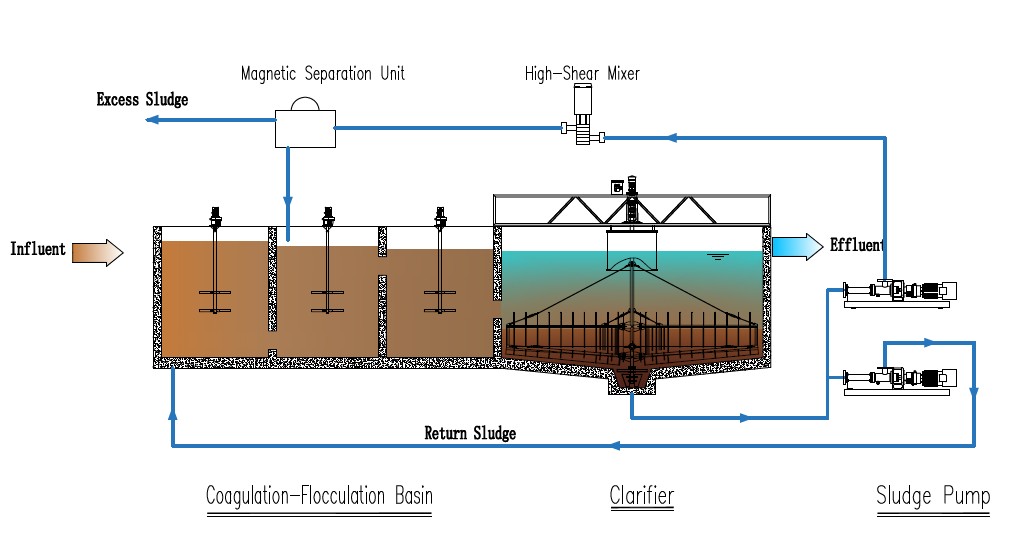
Magnetic Coagulation Technology
Magnetic coagulation technology is a high-efficiency water treatment technology that enhances flocculation and sedimentation effects by adding magnetic powder media.

Core principle
Its core principle is to add magnetic particles (usually micron-sized magnetic powder) to the traditional flocculation and sedimentation process, leveraging the high-density characteristics of the magnetic powder (the specific gravity of the formed magnetic flocs can reach 2.8g/cm³) and surface adsorption characteristics. Through mechanisms such as "adsorption bridging" and "charge neutralization," pollutants in the water such as algae, fine suspended solids, colloids, and bacteria are effectively combined with the magnetic powder to form high-density flocs8. These magnetic flocs can achieve rapid sedimentation and separation under the action of a magnetic field, with the sedimentation time improved by 40% compared to traditional processes1.
The technology system usually consists of three main units: Magnetic powder coagulation unit: adds magnetic powder and flocculants to the raw water to form settleable magnetic flocs; Sedimentation and separation unit: uses high-gradient magnetic fields to achieve rapid solid-liquid separation, where clean water rises and overflows and magnetic flocs settle at the bottom; Magnetic powder recovery unit: separates the settled magnetic powder from the sludge and reuses it to reduce operating costs 78.
The magnetic coagulation system can achieve full-process automated control. Through PLC control and remote monitoring technology, it realizes the automated operation of the entire process, including pH adjustment, chemical dosing flocculation, and sedimentation purification. Built-in algorithms can monitor water quality changes in real-time and dynamically adjust operating parameters.
Applicable scenarios
Magnetic coagulation technology is suitable for various water treatment scenarios due to its high efficiency and compact characteristics:
Expansion and upgrading of municipal sewage treatment plants:
Particularly suitable for the renovation of old plants with limited land, it can significantly increase treatment capacity without requiring additional land. The land footprint per ton of water is only 1/6-1/87 of that of traditional processes.
River basin and lake management and water quality improvement:
Used to remove suspended solids, total phosphorus and algae from water bodies, and control water eutrophication. For example, in the Jiaxing South Lake water quality improvement project, this technology significantly improved the water transparency 7 in a short period of time.
Industrial wastewater treatment:
Suitable for the treatment of high-phosphorus industrial wastewater from petroleum, papermaking, chemical industries, etc., with strong shock load resistance, and can operate stably under high concentration and high pollution loads 8.
Rainy season overflow pollution control:
Aiming at the characteristics of instantaneous large water volume and high load impact of urban drainage systems in the rainy season, it can quickly and efficiently reduce pollutants entering the river. For example, in the Sihe initial rainwater project in Shiyan, Hubei, this technology was used to build an initial rainwater treatment station with a scale of 30,000 m³/d 7.
Decentralized wastewater treatment:
It can be made into mobile equipment for mobile treatment of wastewater, effectively solving problems such as scattered urban wastewater and imperfect pipe networks.
Performance statement
No. | Project Name | Specification | Project Location | Remarks |
1 | Changliu Sewage Treatment Plant Expansion Project | 100000m3/d | Haikou, Hainan | |
2 | Rizhao City-wide Water Environment Comprehensive Treatment PPP Project - Economic Development Zone River Regulation Project Phase II Sewage Wetland Upgrading and Magnetic Flocculation Project | 50000m3/d | Rizhao, Shandong |